Cleveland County Dog Registration Information
Service Dogs and Emotional Support Animals in Cleveland, Oklahoma
Registering a Dog in Cleveland County, Oklahoma (Service Dogs & Emotional Support Dogs)
If you’re asking where do I register my dog in Cleveland County, Oklahoma for my service dog or emotional support dog, the key thing to know is that pet “registration” is usually a local dog license handled by a city animal welfare/animal control office (or sometimes a city clerk), not a single countywide service-dog registry. Your steps and the right office depend on whether you live in Norman, Moore, Noble, another city, or in an unincorporated part of Cleveland County.
Important: A Dog License Is Not the Same as “Service Dog Registration”
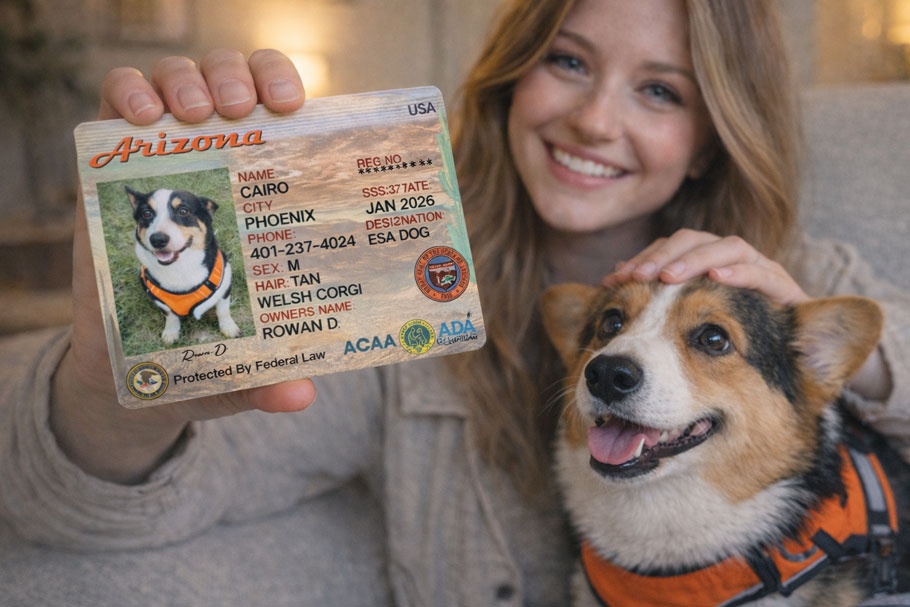
A dog license in Cleveland County, Oklahoma is typically tied to rabies vaccination compliance and local ordinances. A service dog is defined by federal disability law and generally does not require an official ID card, vest, certificate, or registry. An emotional support animal (ESA) may have housing-related protections, but is not the same as a service dog for public access.
Where to Register or License Your Dog in Cleveland County, Oklahoma
Licensing and enforcement are often handled at the city level. Below are examples of official offices within Cleveland County, Oklahoma that may handle pet licensing, registration tied to rabies records, or animal control support. If you live inside city limits, start with your city’s animal welfare/animal control office.
| Office | Address | Phone | Office Hours | |
|---|---|---|---|---|
Cleveland County Health Department (Norman)Public health (rabies / zoonotic guidance)
|
250 12th Ave. N.E. Norman, OK 73071 |
(405) 321-4048 | Not listed | Not listed |
Cleveland County Health Department (Moore)Public health (rabies / zoonotic guidance)
|
424 S Eastern Moore, OK 73160 |
(405) 794-1591 | Not listed | Not listed |
City of Moore Animal Welfare & Adoption CenterAnimal control + pet registration tied to rabies certificate
|
3500 S I-35 Service Rd Moore, OK 73160 |
(405) 793-5190 | animalwelfare@cityofmoore.com |
Adoption Center: Tue–Fri 9am–6pm; Sat 9am–4pm; Sun–Mon Closed
Field Service: Mon–Fri 8am–5pm; Sat 8am–12pm; Sun Closed |
City of Noble Police Department (Animal Welfare / Animal Control)Animal welfare officer / animal control (handled through police)
|
115 N 2nd St. Noble, OK 73068 |
(405) 872-9231 | Not listed | Not listed |
City of Cleveland — City Clerk’s Office (Pet Licensing)Example municipal licensing office
|
105 W Caddo Street Cleveland, OK 74020 |
(918) 358-3506 | Not listed | Not listed |
City of Norman Animal Welfare (Facility Location)Animal welfare services (call for licensing process)
|
3428 Jenkins Avenue Norman, OK 73072 |
(405) 292-9736 | Not listed |
Mon–Fri 10am–5:30pm; Sat 10am–4pm; Sun Closed
|
Which office should you contact first?
- If you live inside a city’s limits (Norman, Moore, Noble, etc.), start with that city’s animal welfare/animal control or city clerk licensing counter.
- If you’re unsure whether you’re in city limits, check your utility billing jurisdiction or ask your city hall/animal welfare office to confirm.
- If your question is specifically about rabies exposure, quarantine, or public health guidance, the Cleveland County Health Department locations listed above are appropriate starting points.
Overview of Dog Licensing in Cleveland County, Oklahoma
What “registration” usually means
In everyday terms, “registering” your dog in Cleveland County often means obtaining a local pet license (sometimes called a registration or tag) through your city. This is why searches like where to register a dog in Cleveland County, Oklahoma can be confusing: there may not be a single countywide office issuing licenses for everyone. Instead, animal control dog license Cleveland County, Oklahoma processes often route through your city animal welfare/animal control department.
Why cities license dogs
Dog licenses help local governments document that pets are vaccinated (especially against rabies), support reuniting lost pets with owners, and provide a mechanism for enforcement when animals are at large or involved in bites. Even if you have a service dog, licensing (where required) is generally still a local public-health and ordinance compliance issue.
How Dog Licensing Works Locally in Cleveland County, Oklahoma
Step 1: Identify your jurisdiction (city limits matter)
The first step in getting a dog license in Cleveland County, Oklahoma is determining whether you live inside a city that runs its own animal welfare program. For example, Moore specifically states that city residents are required to register pets and bring a current rabies certificate to obtain a city license/tag. Norman and Noble also operate animal welfare/animal control functions within their jurisdictions.
Step 2: Get your dog’s rabies vaccination current
Most local licensing systems depend on proof of current rabies vaccination. Rabies vaccination is a core requirement in many municipal ordinances and is commonly enforced through animal welfare officers, bite investigations, and licensing rules. If your dog’s rabies vaccination is expired, schedule a veterinary appointment first so your license application is not delayed.
Step 3: Bring documentation and pay the fee
Cities commonly require you to provide the rabies certificate and pay a licensing fee. Some places set different fees based on whether the pet is altered (spayed/neutered) or not, and some licenses may follow a one-year cycle or be tied to the rabies expiration date. If you’re registering a new dog, ask whether the city issues a physical tag, printed license, or record only.
Step 4: Keep proof accessible
Once licensed (or otherwise recorded in your city’s system), keep your dog’s rabies certificate and any license documentation in a safe place. This can be helpful if your dog is lost, if an animal welfare officer requests proof, or if you’re dealing with a landlord or housing provider. For service dog handlers, it’s also wise to keep health documentation handy because service dogs must still comply with local health requirements, even though “service dog registration” is not generally required by law.
Service Dog Laws in Cleveland County, Oklahoma
What makes a dog a service dog (and what does not)
A service dog is a dog that is individually trained to do work or perform tasks for a person with a disability. The task training is the key—not a vest, a certificate, an online “registration,” or an ID card. Because the legal status is based on disability-related task training, there typically is no official government registry you must use in order for your dog to be considered a service dog.
Public access vs. licensing
Public access rights for service dogs are separate from local licensing rules. In other words: your service dog may have public access protections, while your city may still require a local dog license or proof of rabies vaccination. When people search “animal control dog license Cleveland County, Oklahoma” for a service dog, the best approach is to handle the two tracks separately: (1) comply with your local licensing/rabies requirements, and (2) understand your federal protections for public access.
What businesses can ask (in practice)
Businesses generally should not demand paperwork that “proves” your dog is a service dog. However, in real life, disputes often happen when staff confuse service dogs with ESAs. If you want to reduce friction, focus on what you can reliably provide: your dog’s calm behavior, your ability to answer permissible questions about the dog’s trained task(s), and compliance with local health rules (like rabies vaccination).
Emotional Support Animal Rules in Cleveland County, Oklahoma
ESAs are not service dogs
An emotional support animal (ESA) provides comfort by its presence, but it is not necessarily trained to perform disability-related tasks. Because of that, ESAs generally do not have the same public-access rights as service dogs (for example, restaurants and stores do not have to admit ESAs the way they must admit service dogs in many situations).
Where ESAs commonly matter: housing
ESAs most commonly come up in housing contexts (rentals, apartment complexes, or other housing providers). Housing providers may have to make reasonable accommodations for an ESA in certain circumstances, which can involve documentation from a qualified healthcare professional. That said, ESA documentation is a housing issue—not a replacement for a dog license in Cleveland County, Oklahoma where local ordinances require licensing or rabies compliance.
Licensing still applies to ESAs
Even if your dog is an ESA, local rules related to rabies vaccination, leash laws, nuisance behavior, and licensing/registration can still apply. If you’re trying to figure out where to register a dog in Cleveland County, Oklahoma for an ESA, you’ll typically follow the same local process as any other pet owner in your city.
Frequently Asked Questions
Disclaimer
Licensing requirements and office locations may change. Residents should verify details with their local animal services office within Cleveland County, Oklahoma.
Register A Dog In Other Oklahoma Counties
Select your county below to get started with your dog’s ID card. Requirements and license designs may vary by county, so choose your location to see the correct options and complete your pup’s registration.
- Adair County Dog Registration
- Alfalfa County Dog Registration
- Atoka County Dog Registration
- Beaver County Dog Registration
- Beckham County Dog Registration
- Blaine County Dog Registration
- Bryan County Dog Registration
- Caddo County Dog Registration
- Canadian County Dog Registration
- Carter County Dog Registration
- Cherokee County Dog Registration
- Choctaw County Dog Registration
- Cimarron County Dog Registration
- Coal County Dog Registration
- Comanche County Dog Registration
- Cotton County Dog Registration
- Craig County Dog Registration
- Creek County Dog Registration
- Custer County Dog Registration
- Delaware County Dog Registration
- Dewey County Dog Registration
- Ellis County Dog Registration
- Garfield County Dog Registration
- Garvin County Dog Registration
- Grady County Dog Registration
- Grant County Dog Registration
- Greer County Dog Registration
- Harmon County Dog Registration
- Harper County Dog Registration
- Haskell County Dog Registration
- Hughes County Dog Registration
- Jackson County Dog Registration
- Jefferson County Dog Registration
- Johnston County Dog Registration
- Kay County Dog Registration
- Kingfisher County Dog Registration
- Kiowa County Dog Registration
- Latimer County Dog Registration
- LeFlore County Dog Registration
- Lincoln County Dog Registration
- Logan County Dog Registration
- Love County Dog Registration
- Major County Dog Registration
- Marshall County Dog Registration
- Mayes County Dog Registration
- McClain County Dog Registration
- McCurtain County Dog Registration
- McIntosh County Dog Registration
- Murray County Dog Registration
- Muskogee County Dog Registration
- Noble County Dog Registration
- Nowata County Dog Registration
- Okfuskee County Dog Registration
- Oklahoma County Dog Registration
- Okmulgee County Dog Registration
- Osage County Dog Registration
- Ottawa County Dog Registration
- Pawnee County Dog Registration
- Payne County Dog Registration
- Pittsburg County Dog Registration
- Pontotoc County Dog Registration
- Pottawatomie County Dog Registration
- Pushmataha County Dog Registration
- Roger Mills County Dog Registration
- Rogers County Dog Registration
- Seminole County Dog Registration
- Sequoyah County Dog Registration
- Stephens County Dog Registration
- Texas County Dog Registration
- Tillman County Dog Registration
- Wagoner County Dog Registration
- Washington County Dog Registration
- Washita County Dog Registration
- Woods County Dog Registration
- Woodward County Dog Registration